
Research · August 21, 2026
Pennsylvania changes permitting and state support for data centers
On 18 August 2026, Governor Josh Shapiro signed Executive Order 2026-05, changing how Pennsylvania permits and powers data centers. Most of the state's large pipeline is still proposals, and only one of the nine former Fast Track campuses has verified operating AI-capable capacity.

Research
Pennsylvania changes permitting and state support for data centers
A4 PDF · 1 pages · 84 KB · 20 August 2026
Download PDFWhat the order changes
The EO eliminates Fast Track applications. New tax-exemption applicants must follow the Governor's Responsible Infrastructure Development (GRID) requirements. State agencies cannot use NDAs, and the Department of Environmental Protection (DEP) must publish project data. Existing permits remain valid, as do the 23 permit records still pending across the nine former Fast Track projects.
Grid connections are still allowed but the order asks regulators to make data centers pay connection and reliability costs. During an emergency, utilities may reduce their power first unless they secure enough new capacity.
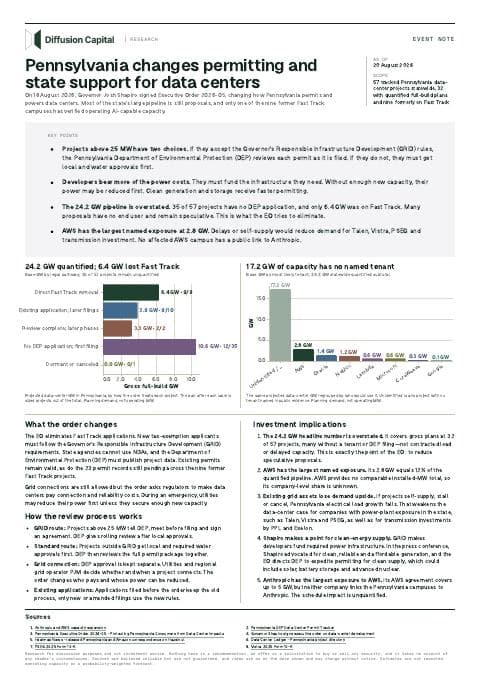
24.2 GW quantified; 6.4 GW lost Fast Track
Base GW by legal pathway; 25 of 57 projects remain unquantified
Gross full-build capacity grouped by the project pathway through Executive Order 2026-05.
Projected data-center GW in Pennsylvania, by how the order treats each project. The pair after each label is sized projects out of the total. Planning demand, not operating MW.
Source: Pennsylvania DEP Data Center Project Tracking CSV, Pennsylvania Executive Order 2026-05 - Protecting Pennsylvania Consumers from Data Center Impacts, Data Center Ledger - Pennsylvania project directory · 2026-08-20
How the review process works
- GRID route: Projects above 25 MW tell DEP, meet before filing and sign an agreement. DEP gives rolling review after local approvals.
- Standard route: Projects outside GRID get local and required water approvals first. DEP then reviews the full permit package together.
- Grid connection: DEP approval is kept separate. Utilities and regional grid operator PJM decide whether and when a project connects. The order changes who pays and whose power can be reduced.
- Existing applications: Applications filed before the order keep the old process, only new or amended filings use the new rules.
17.2 GW of capacity has no named tenant
Base GW by most likely tenant; 24.2 GW statewide quantified subtotal
Gross full-build capacity grouped by the most likely tenant or an unidentified and undisclosed category.
The same projected data-center GW, regrouped by who would use it. Unidentified is any project with no tenant named in public evidence. Planning demand, not operating MW.
Source: Pennsylvania DEP Data Center Project Tracking CSV, Data Center Ledger - Pennsylvania project directory, Heatmap News - released Pennsylvania and Amazon correspondence on Hazelnut · 2026-08-20
Investment implications
-
The 24.2 GW headline number is overstated. It covers gross plans at 32 of 57 projects, many without a tenant or DEP filing—not contracted load or delayed capacity. This is exactly the point of the EO: to reduce speculative proposals.
-
AWS has the largest named exposure. Its 2.8 GW equals 12% of the quantified pipeline. AWS provides no comparable installed-MW total, so its company-level share is unknown.
-
Existing grid assets lose demand upside. If projects self-supply, stall or cancel, Pennsylvania electrical load growth falls. That weakens the data-center case for companies with power-plant exposure in the state, such as Talen, Vistra and PSEG, as well as for transmission investments by PPL and Exelon.
-
Shapiro makes a point for clean-energy supply. GRID makes developers fund required power infrastructure. In the press conference, Shapiro advocated for clean, reliable and affordable generation, and the EO directs DEP to expedite permitting for clean supply, which could include solar, battery storage and advanced nuclear.
-
Anthropic has the largest exposure to AWS. Its AWS agreement covers up to 5 GW, but neither company links the Pennsylvania campuses to Anthropic. The schedule impact is unquantified.
Sources
- Anthropic and AWS capacity expansion — Forward Trainium deployment schedule. official company announcement
- Pennsylvania DEP Data Center Permit Tracker — Current project and permit status for Pennsylvania data centers. official live tracker
- Pennsylvania Executive Order 2026-05 - Protecting Pennsylvania Consumers from Data Center Impacts — Controlling Fast Track removal and post-order DEP review rules. official executed order
- Governor Shapiro signs executive order on data-center development — Administration summary and stated rationale for Executive Order 2026-05. official government release
- Heatmap News - released Pennsylvania and Amazon correspondence on Hazelnut — Unannounced AWS role at Project Hazelnut. investigative reporting based on public-record emails
- Data Center Ledger - Pennsylvania project directory — Secondary statewide project-name capacity and status cross-check. independent project directory with primary-source links
- PSEG 2025 Form 10-K — PSEG ownership of Pennsylvania nuclear generation. SEC filing
- Vistra 2025 Form 10-K — Vistra generation assets in Pennsylvania. SEC filing