
Research · August 21, 2026
US debt at forty trillion and no quick fix for the long end
US debt passed $40tn as the Fed and foreign reserve managers reduced their holdings. Private investors now absorb more supply and seek higher yields. Treasury's buyback briefly lowered the thirty-year yield but did not reduce net supply. Lasting relief will require other measures.

Research
US debt at forty trillion and no quick fix for the long end
A4 PDF · 2 pages · 168 KB · 21 August 2026
Download PDFDomestic funds absorbed what governments gave up
Estimated ownership of Treasury securities, quarterly
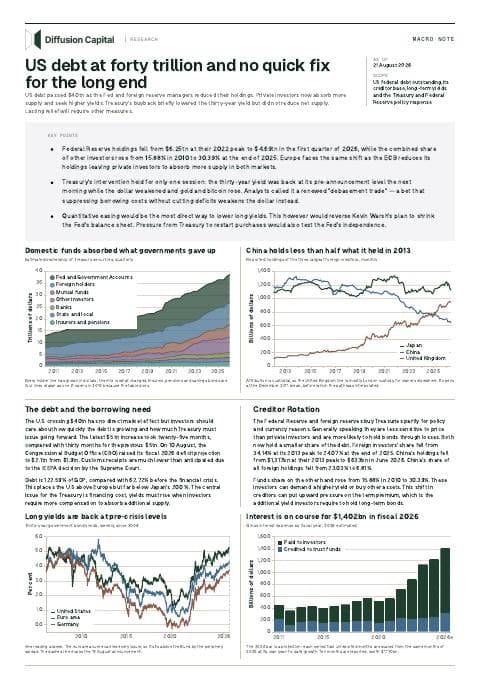
A stacked area from 2010 to December 2025 in which the total roughly triples. The Federal Reserve with the government accounts and foreign holders together fall from about three quarters of the stack to about half, while mutual funds and other investors expand to take their place.
Every holder line has grown in dollars; the mix is what changed. Insurers, pensions and savings bonds are four lines drawn as one. It opens in 2010 because the table does.
Source: US Treasury Bulletin - Ownership of Federal Securities, table OFS-2 · 2026-08-21
China holds less than half what it held in 2013
Reported holdings of the three largest foreign creditors, monthly
Three monthly lines from January 2012 to June 2026. Japan stays above one trillion dollars, mainland China falls from about one and a quarter trillion to six hundred billion, and the United Kingdom rises from near one hundred billion to over nine hundred billion.
Attribution is custodial, so the United Kingdom line is mostly London custody for owners elsewhere. It opens at the December 2011 break, before which the path was interpolated.
Source: US Treasury - Historical Major Foreign Holders Table, US Treasury International Capital - Major Foreign Holders, official and total · 2026-08-21
The debt and the borrowing need
The U.S. crossing $40tn has no direct market effect but investors should care about how quickly the debt is growing and how much Treasury must issue going forward. The latest $5tn increase took twenty-five months, compared with thirty months for the previous $5tn. On 10 August, the Congressional Budget Office (CBO) raised its fiscal 2026 deficit projection to $2.1tn from $1.9tn. Customs receipts are much lower than anticipated due to the IEEPA decision by the Supreme Court.
Debt is 122.59% of GDP, compared with 62.72% before the financial crisis. This places the U.S above Europe but far below Japan's 200 %. The central issue for the Treasury is financing cost, yields must rise when investors require more compensation to absorb additional supply.
Creditor Rotation
The Federal Reserve and foreign reserves buy Treasuries partly for policy and currency reasons. Generally speaking they are less sensitive to price than private investors and are more likely to hold bonds through losses. Both now hold a smaller share of the debt. Foreign investors' share fell from 34.14% at its 2013 peak to 24.07% at the end of 2025. China's holdings fell from $1,317bn at their 2013 peak to $633bn in June 2026. China's share of all foreign holdings fell from 23.03% to 6.81%.
Funds share on the other hand rose from 15.88% in 2010 to 30.39%. These investors can demand a higher yield or buy other assets. This shift in creditors can put upward pressure on the term premium, which is the additional yield investors require to hold long-term bonds.
Long yields are back at pre-crisis levels
Thirty-year government bond yields, weekly, since 2006
Three weekly lines from 2006. All three fall from around five per cent to troughs near or below one per cent in 2020 and 2021, then climb back, with the United States above five per cent again in 2026 and Germany and the euro area below it.
One reading a week. The euro area curve carries every issuer, so it sits above the Bund by the periphery spread. The dashed line marks the 19 August announcement.
Source: US Treasury - daily Treasury par yield curve rates, Deutsche Bundesbank - yields derived from the term structure of Federal securities, 30-year residual maturity, European Central Bank - euro area government bond yield curve, 30-year spot rate, all issuers, FRED - federal debt held by Federal Reserve banks and by foreign investors · 2026-08-21
Interest is on course for $1,402bn in fiscal 2026
Gross interest expense by fiscal year, 2026 estimated
Stacked bars for each fiscal year from 2011, showing interest paid to investors rising far faster than interest credited to the trust funds. The final bar, labelled 2026e, is an estimate and the tallest.
The 2026 bar is a projection: each series' two unreported months are scaled from the same months of 2025 at its own year-to-date growth. Ten months are reported, worth $1,170bn.
Source: US Treasury Fiscal Data - Interest Expense on the Public Debt Outstanding · 2026-08-21
Europe's long end repriced too
Germany's thirty-year yield reached 3.76% on 19 August, its highest level since July 2011. We see a similar pattern in Europe where the euro-area all-issuer yield reached 4.34%, its highest since September 2012.
Germany's thirty-year yield has risen by 117bp since the end of 2024. About 36bp came in the two weeks before the Bundestag approved the debt-brake amendment on 18 March 2025. A further 33bp came during the rest of 2025 while the ten-year barely moved, a steepening the ECB attributes to real rates and a global component. Another 33bp came this year. The ECB raised its deposit rate on 17 June, and the two-year is now 55bp above it.
Europe broadly is seeing a similar creditor rotation. Amundi expects ECB holdings to fall by about €384bn this year, more than three quarters of net issuance again, so private investors take close to twice the new issuance. Barclays sees gross supply at a record €1.54tn next year. More paper against unchanged appetite clears at a lower price, and buyers are stepping back from the very long end into tens.
What Treasury did
On 19 August, The Treasury said it would at least double the maximum buyback in the 10–20-year and 20–30-year nominal sectors. Secretary Bessent emphasised that the Treasury could buy more than $4 billion worth of long-term bonds. Treasury said the long-end operations routinely receive enough high-quality offers to justify a larger limit. The decision nevertheless revised a schedule published two weeks earlier, making it an unusual departure from the regular quarterly process.
The stated justification for the programme is to remove less-liquid "off-the-run" securities from the market. It effectively aims to reduce supply of long-end bonds which in turn reduces yields of those Treasury bonds. It's clear that the Treasury is uncomfortable with the rise of long-term yields and is trying to intervene in the sell-off. High budget deficits remain an issue that forces the US to either accept higher borrowing costs, tighten fiscal policy or let the dollar weaken. Wall Street is starting to speculate about a return of the "debasement trade".
The buyback rally lasted one session
Cboe thirty-year yield index, five minutes, 18 to 20 August 2026
A five-minute line across three sessions. It drifts down through 18 August, drops sharply just after half past eight on the 19th, trades lower all day, and opens back at the pre-release level on the 20th before easing again.
The index runs 08:20 to 15:00 in New York. The plain rules mark where the overnight hours fall; the dashed ones mark the 08:30 release and the last print before it.
Source: Cboe thirty-year US Treasury yield index (TYX), intraday, US Treasury press release sb0607 - increased sizes of nominal long-end liquidity support buybacks · 2026-08-21
QE held down the 10-year yield through 2014
Weekly yield; shaded periods mark Fed bond-purchase programmes
The weekly ten-year Treasury yield from 2008 through 2014, with shaded windows for QE1, QE2, Operation Twist and QE3. Labels show Federal Reserve staff estimates that the programmes lowered the yield by 12 to 34 basis points at launch.
Observed yield, not a no-QE counterfactual. Fed staff estimate reductions of 12–34bp at launch and about 100bp cumulatively by end-2016; other macro forces also moved yields.
Source: FRED - Market Yield on U.S. Treasury Securities at 10-Year Constant Maturity, Federal Reserve - The Effect of the Federal Reserve's Securities Holdings on Longer-term Interest Rates · 2026-08-21
Why the rally failed
The market response to the intervention lasted only one session. The thirty-year yield fell from 5.27% before the release to 5.19% fifteen minutes later and reached 5.18% that morning. By the next morning, it was back at 5.27%, close to its pre-announcement level. In a press conference Bessent acted somewhat surprised by the reaction.
These buybacks are too small to change the Treasury market's overall supply-demand balance. The announcement also came outside the regular quarterly refunding process, which may make debt management less predictable. On the same day, President Trump also declared "Economic D-Day" on Iran and threatened sanctions against countries that trade with Iran. China buys more than 80% of Iran's exported oil and is therefore the main country exposed. It's unlikely that the U.S. would create further trade tension with China prior to the Trump–Xi meeting in September but even a hint of escalation can introduce further uncertainty into an already volatile market.
A resolution of the Iran war would reduce the energy-risk premium in long-term yields. Shipping through the Strait of Hormuz remains far below normal. Lloyd's counted 73 large-vessel transits in the week to 16 August, or roughly ten per day, compared with a pre-crisis rate of about 73 per day. Some vessels travel with their tracking systems switched off, so the precise count is uncertain.
Treasury's remaining options
Lower borrowing would be Treasury's main route to a lasting reduction in yields. This would require tighter fiscal policy or higher revenue. Treasury Secretary Scott Bessent entered office with a 3-3-3 economic plan intended to boost growth and curb government spending, but progress on both goals is lagging behind. Lower inflation would also reduce the yield investors demand. Bessent said the administration would present a fiscal-consolidation plan but has not provided details. It's unlikely anything will be presented before this year's midterm elections.
Issuing more bills and fewer long bonds would also reduce near-term long-bond supply. It would increase refinancing risk however and leave more debt exposed to short-term rates. Larger, regularly scheduled buybacks may improve liquidity, but Treasury must finance them by issuing other debt.
The Fed's options—and Warsh's constraint
The Fed has a more direct way to reduce long yields. Under quantitative easing, it buys long bonds and holds them on its balance sheet. This removes duration from private portfolios. By the end of 2016, Fed staff estimated that QE1 through QE3 and Operation Twist had reduced the ten-year term premium by about 100bp in total, with each programme lowering it by an estimated 12–34bp at launch. The Fed could also use a maturity swap or limited purchases. Rate cuts may lower long yields by changing the expected path of short-term rates, but the current inflation is making this step unlikely in 2027.
Kevin Warsh has argued for a smaller Fed portfolio with shorter maturities. A sustained QE programme would conflict with that objective, so Fed purchases are unlikely unless market functioning deteriorates. Treasury can ask the Fed to coordinate, but it cannot require an independent central bank to buy bonds. Any public request for purchases would test Warsh's balance-sheet stance and the Fed's operational independence.
Sources
- Amundi Research Center - European bonds in 2026 and beyond, strong supply and strong demand — the size of ECB runoff against euro area net issuance. published sell-side research
- Deutsche Bundesbank - yields derived from the term structure of Federal securities, 2-year residual maturity — the German two-year yield, the tenor that prices the ECB path. public REST API
- Deutsche Bundesbank - yields derived from the term structure of Federal securities, 30-year residual maturity — the German thirty-year government yield, daily. public REST API
- Noerr - Bundestag approves exemption from the debt brake for defence spending and special funds — the German fiscal regime change the first leg of the rise prices. published legal analysis
- Congressional Budget Office - fiscal 2026 deficit projection, August 2026 update — the borrowing requirement behind the August repricing. official projection reported 10 August 2026
- Cboe thirty-year US Treasury yield index (TYX), intraday — the five-minute path of the thirty-year yield across the buyback announcement. public JSON API via Yahoo Finance
- Council on Foreign Relations - What the Treasury's Buyback Surprise Says About the Bond Market — the limits of Treasury buybacks and the durable options for lowering long yields. expert analysis
- CNBC transcript - Treasury Secretary Scott Bessent on Squawk on the Street, 20 August 2026 — the Secretary's own account of the buyback expansion and the fiscal plan behind it. published interview transcript
- CNBC - Warsh faces Fed independence test as Bessent moves in on the central bank's turf — the institutional question raised by Treasury acting on long-term yields. news report
- European Central Bank blog - Sloping up: the repricing of euro area yields in 2025 — the ECB's own account of what drove the 2025 steepening. official blog post
- European Central Bank - euro area government bond yield curve, 30-year spot rate, all issuers — the euro area thirty-year government yield including the periphery. public REST API
- European Central Bank - key ECB interest rates, deposit facility — the policy rate the German two-year is measured against. public REST API
- European Central Bank - monetary policy decisions, 11 June 2026 — the first ECB increase since 2023 and the reason given for it. official press release
- Federal Reserve - The Effect of the Federal Reserve's Securities Holdings on Longer-term Interest Rates — model estimates of QE and Operation Twist effects on the ten-year Treasury term premium. official research note
- FRED - Market Yield on U.S. Treasury Securities at 10-Year Constant Maturity — the observed ten-year Treasury yield during the Federal Reserve purchase programmes. official Federal Reserve Board H.15 series distributed by FRED
- FRED - federal debt held by Federal Reserve banks and by foreign investors — the long-run holder series that reaches back before the Treasury Bulletin table. official Financial Accounts series distributed by FRED
- IMF PortWatch - Strait of Hormuz daily transit calls — the AIS-based measure of how little is moving through the strait. public dashboard
- Lloyd's List Intelligence - Strait of Hormuz Brief, 19 August 2026 — the tracked-shipping count that includes vessels running dark. published maritime intelligence
- Reuters - Treasury buyback renews dollar-debasement fears — how markets outside Treasuries read the buyback. published news report
- Reuters - Record German debt sales deepen strains for Europe's battered bond market — the euro area supply outlook and how investors are positioning against it. published news report
- US Treasury Bulletin - Ownership of Federal Securities, table OFS-2 — the official quarterly estimate of who holds Treasury securities. public JSON API
- TreasuryDirect - FAQs about Treasury Securities Buybacks — the standing purpose mechanics and limits of Treasury liquidity-support buybacks. official programme guidance
- US Treasury press release sb0607 - increased sizes of nominal long-end liquidity support buybacks — the 19 August 2026 decision to at least double long-end buyback operation sizes. official press release
- US Treasury Fiscal Data - Interest Expense on the Public Debt Outstanding — gross interest accrued on the federal debt by fiscal year. public JSON API
- US Treasury - Historical Major Foreign Holders Table — Monthly mainland China and total foreign holdings of US Treasury securities. official historical monthly table
- US Treasury International Capital - Major Foreign Holders, official and total — the country ranking of foreign Treasury holdings and the split between official and private holders. official monthly table
- Times of Israel - Declaring 'economic D-Day', Trump says any country trading with Iran will be sanctioned — the presidential statement that landed the same day as the buyback release. published news report